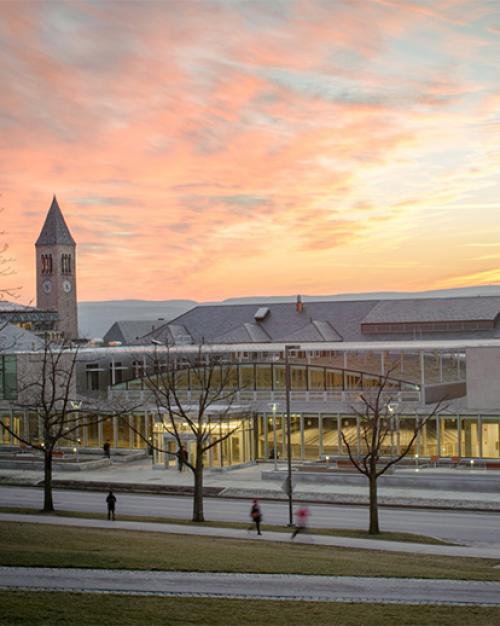
The Cornell Medieval Studies Program is pleased to announce the 37th annual Medieval Studies Student Colloquium (MSSC) in person at Cornell University’s A.D. White House on Saturday, March 13, 2027.
This year’s theme is “Ruptures.”
Abstracts should be 200—300 words and submitted via Google form by December 1st: tinyurl.com/MSSC2027
As Alain Badiou writes: “All resistance is a rupture with what is. And every rupture begins, for those engaged in it, through a rupture with oneself” (Metapolitics, 1998).
Does a moment of rupture signal an end or beginning? In the wake of this radical discontinuity, what remains? Through the theme of “Ruptures,” we invite explorations of the breakthroughs and breakdowns of the Middle Ages. Papers are encouraged to prod the ramifications, resolutions, and reifications of rupture as they appear in a vast range of disciplines and perspectives, including but not limited to considerations of ruptures in objects, bodies, time, literary form, social groups, landscapes, technology, and reality. Where does the “rupture with oneself” appear in writing, and where does it extend beyond the self? We also invite proposals that confront the (im)possibility of a reparative approach to rupture, exploring the question: Can and should ruptures be repaired?
Other possible questions for consideration include:
- In what ways were physical and material ruptures, destructions, or de-constructions performed and felt?
- How can affective responses produce rupture?
- How was the ruptured body conceived of in the Middle Ages? How does the hole interact with the whole?
- How was music conceived not only as a sonic rupture but also as a breakage of time, space, and reality?
- What ruptures defined the periodization and temporal divisions of the Middle Ages?
- How does translation act as a rupture?
- How were ruptures theorized and rationalized by medieval thinkers?
- What are the causes and effects of social rupture? Can cleavages ultimately cleave?
- What ruptures were present in medieval political systems, authorities, and the practice of violence?
- How did medieval authors push up against/test the boundaries of form and genre?
Papers from underrepresented fields and backgrounds are particularly welcome. We invite submissions from all fields and disciplines adjacent to Medieval Studies, including but not limited to Africana Studies, Animal Studies, Anthropology, Archaeology, Art History, Asian Studies, Classics, Comparative Literature, Critical Identity Studies, Disability Studies, Ecocriticism, English Language & Literature, Gender and Sexuality Studies, History, Indigenous Studies, Music Studies, Near Eastern Studies, Philosophy, Politics, Romance Studies, Theology, Trans Studies, and Queer Theory.
If you have questions, please contact this year’s MSSC President, Cagney Kelshaw (cnk36@cornell.edu).